

Letter T Worksheet
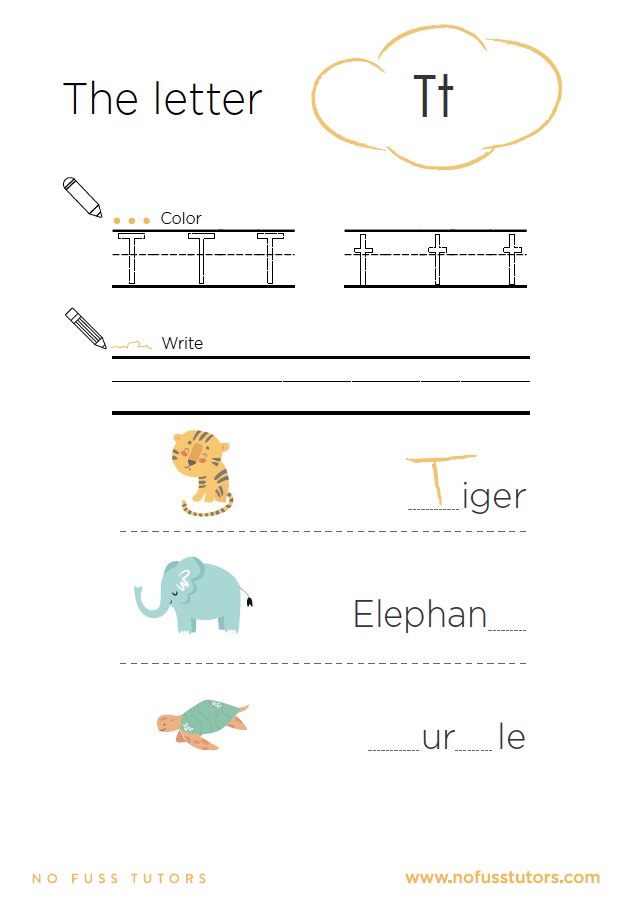
Worksheet on the letter T for preschoolers. Practice tracing the letter T. Practice with printing and tracing both capital T and lower case t. T is for Tiger & Turtle! 🐯🐢

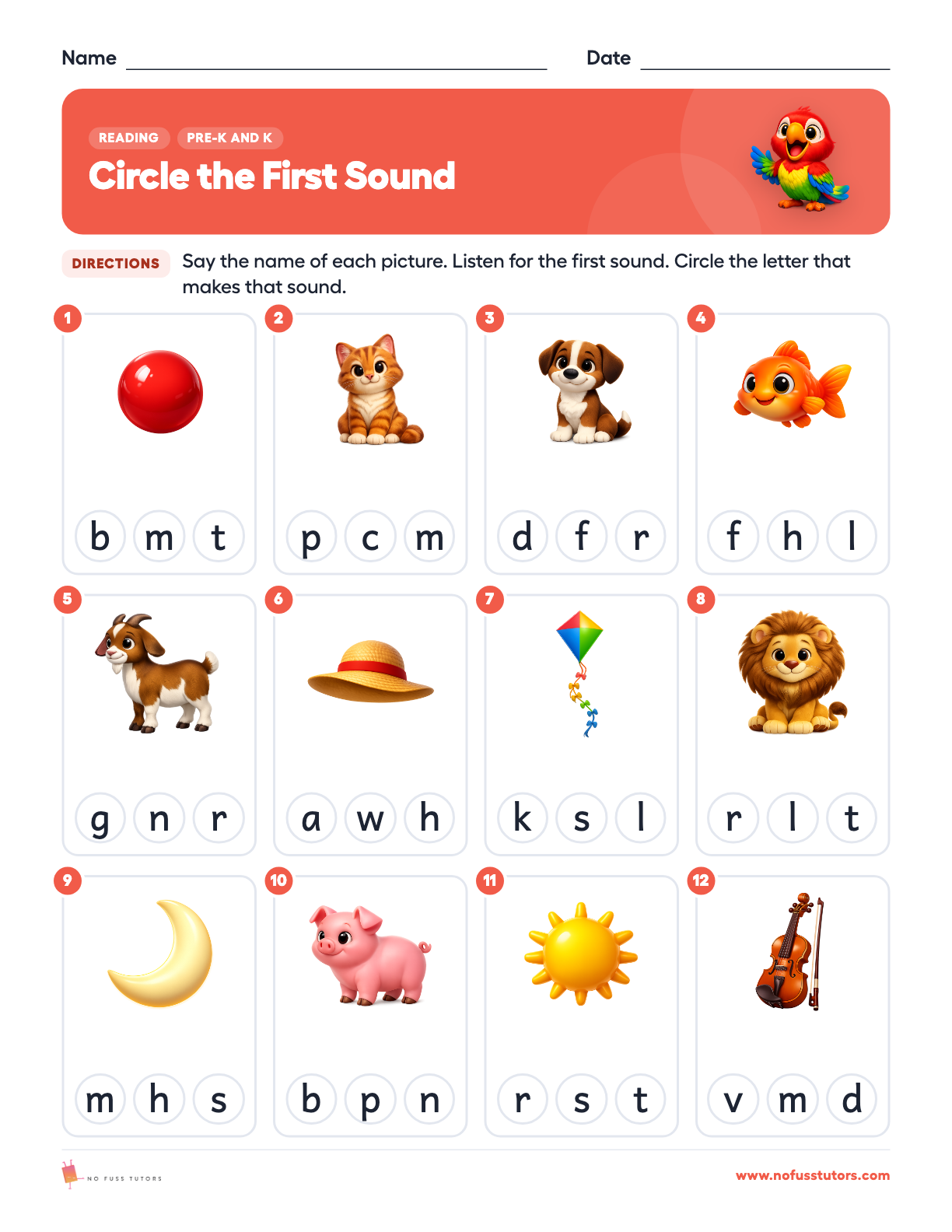

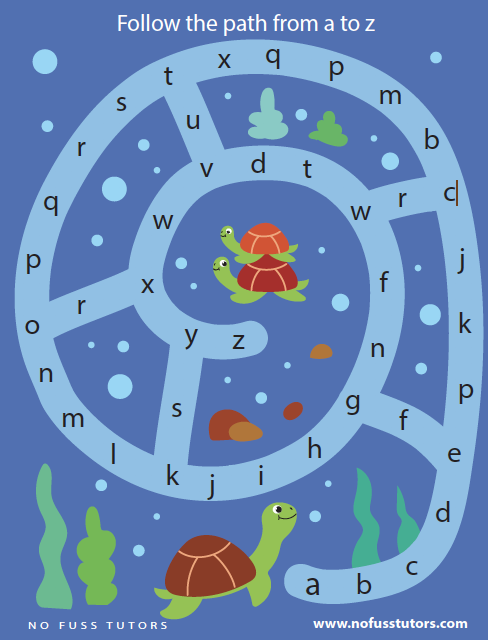

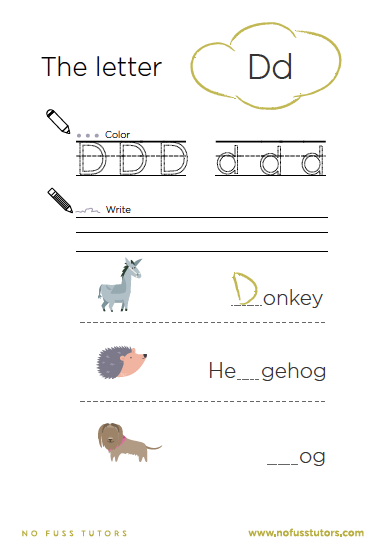
Super Fun Letter T Worksheets for Toddlers
Thinking about what's the best way to get kids excited about writing the letters?
Well, think about this – how do they begin to speak? Infants and toddlers don’t learn how to speak by pronouncing full words. They yackety-yak, they cry softly, and then, by and by, you hear the words come out. This is exactly what they do in writing as well. They start with scribbles, then slowly learn how to form markings, then draw an outline, and many such baby steps before they begin to write properly. Kids could start doing this as early as two years old, or as late as four years.
When they reach this stage, it’s the perfect time to introduce the alphabet. You can help your little one get a boost by aiding them with colorful alphabet worksheets, among other things.
But, getting your little ones to settle down silently for a moment to study seems like a nearly impossible piece of work. Even being serious with them doesn’t work. In fact, being strict is rarely a good approach. The most productive way to make kids pay attention to you as you educate them, is to make teaching seem fun and exciting. There aren’t many teaching tools available that are as enjoyable as our worksheets – the best for writing training and letter recognition.
Benefits of Early Literacy
Extra awareness is being given to early literacy today. Early youth professionals have long acknowledged the significance of literacy and language in preparing kids to get successful in educational institutions. It plays a vital role in authorizing the sort of early learning events that research shows are connected with scholastic gaining, elevated graduation rates, and increased productivity in grown-up life.
Literacy growth is a driving process that enhances over time. Early literacy growth begins in the initial 3 years of a kid’s life and holds up their future language progress, writing, reading, and in general learning. If a toddler can’t read, they can’t grasp. In order for them to progress through subjects like Social Studies, Math, and EVS, they should first be good to read and understand what the material is. Students who face difficulty while reading in school are more likely to get annoyed when they are not able to interpret basic concepts which in return causes them to lose confidence, self-esteem, and attentiveness, and they fall further behind their classmates.
All kids should have access to infancy programs with strong literacy components that include clear adaptations for youngsters with special needs. Early literacy curriculum and teaching modes should be evidence-based, mixed with all domains of learning, and understandable to staff members. Early literacy standards should be practiced that articulate with K-12 programs and show consistency and continuity with overall program targets. Early literacy assessment should use multiple methods and use the knowledge to enhance both teaching and therefore the total preschool program.
Standards for infancy professionals should require staff to satisfy early literacy instructional standards. Parent involvement programs should have a robust early literacy component that guides parents and caregivers in providing early literacy experiences reception. Support for English Learners should be specified and provided in both the house language and English where feasible.
Pronunciation Of The Letter ‘T’
The usual T sound is nearly regularly used when "t" is the primary letter of a word, and st or ts also perpetually keep the natural T sound. For example, take, temple, fast, rats, etc.
When T is between two vowel sounds or between a vowel and L or R, the sound is known as a "flap," which suggests the tongue touches the roof of the mouth quickly. It should be a soft, light sound. This is often the key difference between British and American speech. For example, softer, ability, etc.
When T comes after N, the T sound is down in many words. It's also good to recollect not to articulate a strong T at the midpoint or end of a word as in twenty, inter, ghosted, etc.
When T is before an N, the sound is stopped and turns into a tough N. It may be best to concentrate on it for a short time then start trying to use it. For example, ten, kitten, etc.
When T is at the highest of a word (and this is often not followed by a vowel), the sound stops. To mention this precisely, emphasize the front vowel, put your tongue into place, and solely stop the sound. This one can also be difficult to master, so listen to it carefully first, and then teach your child. For example, cut, lit, dirt, etc.
While going over the pronunciations, make sure you go slow and utter the sounds with emphasis. This will help your child retain better.
The Importance Of Phonics And Their Link With Alphabets
Phonics is a branch of linguistics where the qualities and sonic properties of individual speech sounds are analyzed. It includes the connection between sounds and their spellings, and the other way round. The goal of phonics instruction is to show students the most common sound-spelling relationships so that they can easily decode and sound out the words.
The decoding ability may prove to be a crucial element in reading success, further making phonics reading very essential in every child’s education. The report of the National Reading Panel shows that educating children on phonics will help them in many ways in life. Within the first instance, phonics reading is extremely important in helping children to find out the way to spell words.
The type of phonic education that teaches children the sounds made by individual letter or letter groups (for example, the letter “c” makes a k sound), and teaching children the way to merge separate sounds together to form one word (for example, blending the sounds k,l,o,k makes CLOCK), is usually mentioned as “synthetic phonics”.
Phonics requires the association between sounds and written symbols, whereas phonemic awareness means sounds in spoken words. So, phonics instructions focus on teaching sound-spelling connections and are related to print. Most phonemic awareness tasks are oral. Effective phonics instruction is vital because letter-sound knowledge is that the foundation needed to create up reading and writing abilities.
Benefits Of Doing Letter T Worksheets With Your Toddler
Most children don't have an opportunity to reap the advantages of preschool worksheets. Preschool worksheets are one of the simplest ways for reinforcing learning, which is completed for important subjects including phonics and English, Maths, GK, and life skills. Though, for generations, educators are utilizing worksheets for developing lingual, logical, problem-solving, and logical skills.
The worksheets are an excellent, clever, and entertaining method of instilling learning within the children. One worksheet each day helps keep away the necessity for personal tuition or extra help. Also, because children have a short or no attention span, every worksheet is often finished within seven to ten mins, which results in effective learning.
These fun sheets form the child into a sensible and active being, ready for a far better future. Employing a worksheet is straightforward both for the parent and the child. Worksheets encourage thinking and fine-tune the child’s motor skills as well. Parents and teachers will notice they cover most related topics directly when engaging during a relevant worksheet with kids. Lastly, worksheets give the added advantage of improvement into coloring worksheets where kids can show their creativity while using colors. Undoubtedly, worksheets are a great option!