

Your child reads a page out loud, every word correct. You ask, "So what happened?" and get a blank stare. It is one of the most confusing reading problems for parents, because on the surface everything looks fine.
Reading words and understanding them are two different skills. The good news is that comprehension can be taught, and a lot of it can be practiced in everyday conversation at home. Here is why it happens and eight strategies that help.
Why some kids read the words but do not understand
Researchers often describe reading comprehension with a simple idea called the Simple View of Reading. To understand what they read, children need two things: the ability to decode the words on the page, and the language skills to understand those words if they heard them spoken. If either one is weak, comprehension suffers.
For a child who reads accurately but does not understand, the cause is usually one of these:
Reading takes all their energy
If decoding is slow and effortful, a child spends all their attention on the words and has nothing left for the meaning. They may read correctly but so slowly that by the end of a sentence they have forgotten the beginning. In this case, working on fluency often improves comprehension.
They do not know enough of the words
If a passage has several words your child does not know, the meaning falls apart. Vocabulary is one of the strongest drivers of comprehension, especially from third grade on.
They lack background knowledge
A story about a hockey game is much easier to follow if you know what hockey is. Children with less knowledge about a topic find it harder to understand texts about it, even when they can read every word.
They read passively
Strong readers constantly ask themselves questions, make pictures in their heads and notice when something does not make sense. Many children do not do this naturally and need to be shown how.
8 reading comprehension strategies for kids
Use these when you read together, whether you are reading aloud to your child or they are reading to you. Pick one or two to focus on at a time rather than trying them all at once.

1. Preview before reading
Before opening the book, look at the title, cover and pictures together. Ask, "What do you think this will be about?" and "What do you already know about this?" This switches on background knowledge and gives your child a reason to read: to find out if they were right.
2. Pre-teach tricky words
Skim the page first and pick out two or three words your child may not know. Explain them in simple language and use them in a sentence before reading. Then, when your child meets the words in the text, they already have a hook to hang them on.
3. Stop and check
Pause at the end of a page or paragraph and ask a simple question: "What just happened?" or "Who is talking now?" Teach your child to do this themselves and to reread when they cannot answer. Noticing when meaning breaks down is one of the most important comprehension habits.
4. Make a movie in your mind
Ask your child to picture the scene. "What does the cabin look like? What can you hear?" For a child who struggles, try drawing a quick sketch of what happened in a chapter. Visualizing turns words into something they can see and remember.
5. Ask questions while reading
Model your own wondering out loud: "I wonder why she hid the letter." Then invite your child to ask questions too. Mix up the kinds of questions. Some answers are right there in the text. Others need your child to think and connect clues, like "How do you think he feels? How can you tell?"
6. Retell in order
After reading, ask your child to tell you what happened at the beginning, in the middle and at the end. For nonfiction, ask them to tell you three things they learned. Retelling shows you quickly how much they understood, and it helps them organize the information in their heads.
7. Summarize in one sentence
Once retelling is easy, challenge your child to sum up a chapter or article in one sentence. "Somebody wanted something, but something got in the way, so they did something" is a handy frame for stories. Summarizing forces them to decide what matters most.
8. Notice how the text is built
Nonfiction texts are organized in predictable ways, such as cause and effect, compare and contrast, or problem and solution. Pointing these out helps children know what to look for. Our article on text structure explains the common types.
Everyday habits that build comprehension
Some of the most powerful ways to build comprehension do not involve worksheets at all:
- Read aloud to your child, even if they can read on their own. Choose books slightly above their own reading level to stretch their vocabulary.
- Talk a lot. Discuss the news, explain how things work, and answer their questions with real detail.
- Use rich words in conversation and explain them: "That was a cautious move. Cautious means careful."
- Follow their interests with books, documentaries and trips. Knowledge about the world makes future reading easier.
- Let them read the same favorite books again. Familiar text frees up attention for deeper thinking.
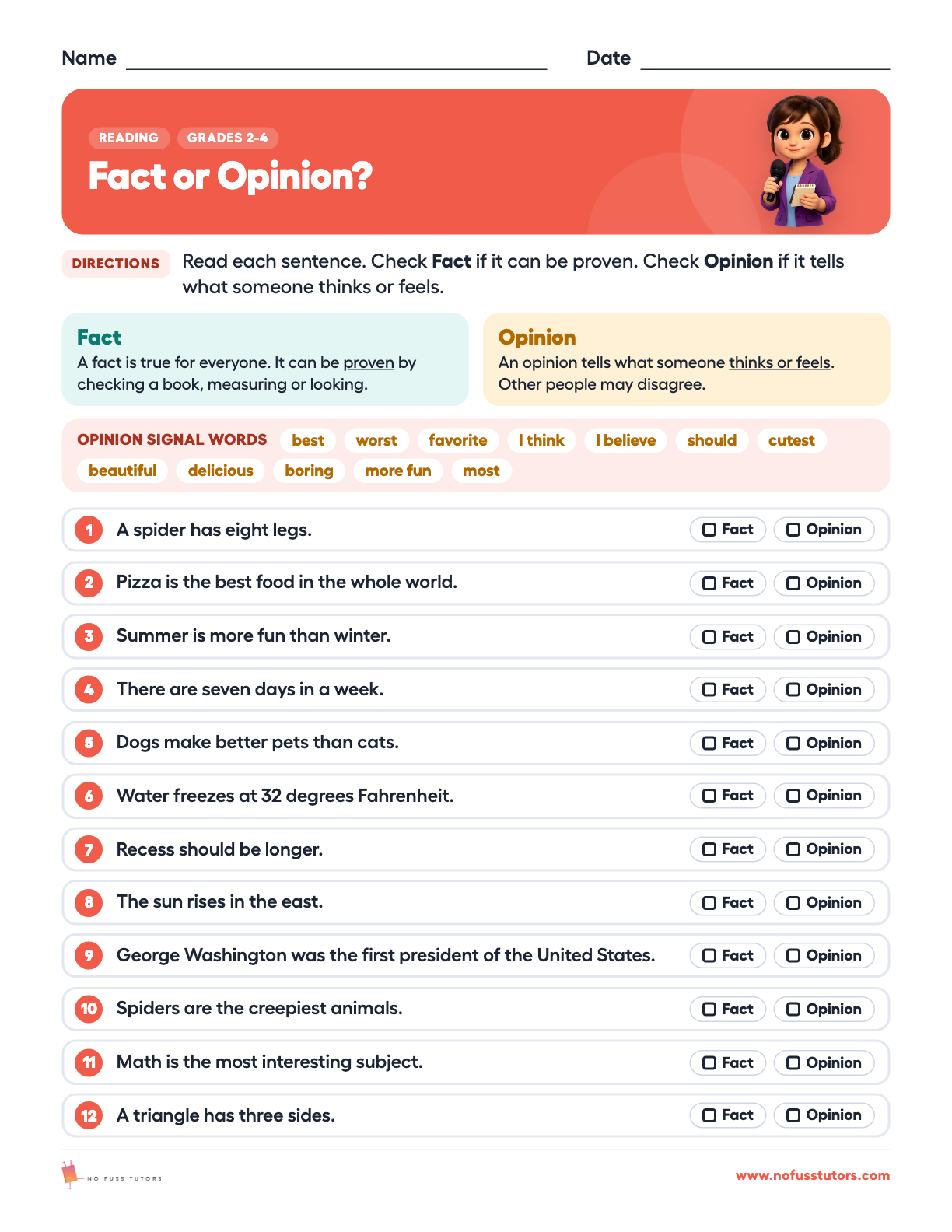
For extra practice, our reading comprehension worksheets include short passages with questions for different grade levels.
Check that decoding is not the real problem
Before focusing only on comprehension, listen to your child read aloud. If they are slow, skip words or make lots of small errors, the root of the problem may be decoding or fluency rather than understanding. In that case, work on those skills first. Our guide for parents whose child is behind in reading explains how to find the gap.
When to get extra help
If your child consistently cannot tell you what they read, even with short passages at a comfortable level, or comprehension is affecting their grades in other subjects, a tutor can help. A tutor can figure out whether the issue is decoding, fluency, vocabulary or comprehension strategies, then teach exactly what is missing.
No Fuss Tutors offers 1-on-1 online reading comprehension tutoring for kids across the US and Canada, on a live video call with a colorful interactive whiteboard. Our Reading Boost Program is grounded in the Science of Reading and covers phonological awareness, phonics, vocabulary, fluency and comprehension, so we can support your child wherever the gap is.
Frequently asked questions
Why can my child read but not understand?
Usually because decoding still takes a lot of effort, they do not know enough of the words, they lack background knowledge about the topic, or they read without actively thinking about the meaning. Each of these can be improved with practice.
At what age does reading comprehension become important?
Comprehension matters from the very first stories you read aloud. It often becomes more noticeable around third grade, when children are expected to read longer texts on their own and learn new information from them.
Does reading aloud to older children help comprehension?
Yes. Reading aloud exposes children to richer vocabulary and more complex ideas than they can usually read on their own. Talking about the book together builds comprehension skills at the same time.
How can I tell if my child understood what they read?
Ask them to retell the story in their own words, in order. If they can explain the main events and why they happened, they understood it. If they can only repeat a few details or copy sentences from the text, they may need more support.


